



Explosion Protection or Digitalization for Automation?

The trend toward digitalization is unstoppable. Process automation is also addressing it at many different levels. New acronyms such as APL (Advanced Physical Layer), NOA (NAMUR Open Architecture), OPAF (Open Process Automation™ Forum), or MTP (Module Type Package) appear in almost every current technical publication.
Unlike industrial automation, however, the process industry faces an additional challenge: hazardous (explosion-prone) areas in many chemical, pharmaceutical, and oil & gas plants. In particular, IP communication down to the field level plays a key role in these industries and within the new concepts. The NAMUR recommendation NE168, “Requirements for an Ethernet communication system for the field level,” therefore also calls for “appropriate explosion protection” for “Ethernet in the Field” solutions.
In the past, the type of protection “intrinsic safety” in accordance with DIN EN 60079-11 has proven itself in these industries and is well established globally. However, depending on the application and requirements, other solutions may also be appropriate.
The following sections discuss the various concepts and their relationship to explosion protection, with a particular focus on “Ethernet in the field.”
New Concepts Are Needed – NOA, OPAF, MTP
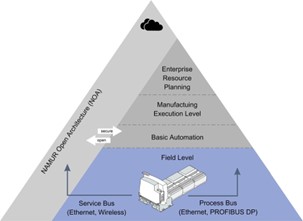
The automation pyramid as the basic architecture in process automation is certainly not obsolete – however, work is increasingly being done at its foundation. In the NAMUR Open Architecture (NOA) project, the classical pyramid is still used, but extended with additional functions. This approach is ideal for both plant expansions (brownfield) and new installations (greenfield).
This extension, also referred to as the “second channel,” is primarily used to make additional information from processes and field devices available. The second channel can either be implemented as additional infrastructure, especially in brownfield applications, or use the existing infrastructure, which is more efficient but usually only feasible in greenfield projects.
With modern remote I/O systems featuring Ethernet connectivity, this structure can be achieved relatively easily and, with certified products now available from several manufacturers, even in hazardous areas up to Zone 1. Network connection is then established either via explosion-protected fiber optics (DIN EN 60079-28) or intrinsically safe copper Ethernet – more on this later.
In existing plants, a remote I/O system continues to communicate with the control system, e.g., via classic PROFIBUS DP. In parallel, an Ethernet network can be connected as a second channel, either directly or via suitable PROFIBUS/Ethernet gateways. This second channel provides extended information and diagnostics based on HART data.
When upgrading a control system to, for example, PROFINET, the required Ethernet infrastructure is already in place, and the process bus is migrated to PROFINET communication – resulting in a single physical network for process data, diagnostics, and HART information.
Access to this additional data from engineering stations or cloud systems was previously done via integrated web servers or FDT/DTM. Today, explosion-protected remote I/O systems such as the R. STAHL IS1+ with integrated OPC UA server are also available, and modern FDI (Field Device Integration) technology will soon be usable as well.
Within the framework of NAMUR Open Architecture, the open standard OPC UA (Open Platform Communications Unified Architecture) is gaining importance due to its vendor- and platform-independent data exchange capabilities. OPC UA not only transfers data from devices or machines, as many other protocols do, but can also describe it in a machine-understandable way – so-called semantics. This requires corresponding information models of devices and systems, defined in OPC UA “Companion Specifications.”
While many such specifications already exist for industrial applications such as robotics, process automation has been less represented so far. In 2017, the FieldComm Group (FCG), together with the OPC Foundation and later supported by NAMUR and PROFIBUS/PROFINET International, began defining the Process Automation Device Information Model (PA-DIM), which is currently available in version 1.02.
This allows device data to be accessed independently of the real-time protocol used (e.g., HART via remote I/O) and made available via Ethernet and OPC UA to other systems and the cloud. PA-DIM thus provides the interface between OT and IT.
Within the current NOA Implementation Project in cooperation between NAMUR and ZVEI, the concept has already been successfully tested in an approximately 25-year-old existing plant using PROFIBUS DP and the R. STAHL IS1+ system in Zone 1.
The Open Process Automation™ Forum (OPAF) goes one step further. Here, the classic pyramid is abandoned in favor of decentralized structures. Process control level, control level, and parts of the field level such as remote I/Os, wireless gateways, or analyzers are connected on a single level via a real-time bus – which itself can be based on Ethernet with OPC UA.
A key focus of OPAF is end-to-end, open interoperability between different manufacturers up to full interchangeability of components. This is a revolutionary approach that will still take time before being widely adopted in process plants – especially when considering critical installations in hazardous areas and high availability requirements.
The basic OPAF concept has already been successfully tested by ExxonMobil (USA) in a field trial with R. STAHL remote I/Os in a non-Ex installation.
A further advanced concept is modular automation, which has already been incorporated into NOA and OPAF. The basic idea is to design recurring applications, machines, or package units only once and then integrate them as modules – referred to as Process Equipment Assemblies (PEA) – into the process level, the Process Orchestration Layer (POL), via a standard interface, the Module Type Package (MTP).
This enables significant savings in planning and commissioning as well as through reusability. The core of this concept is the standardized Module Type Package (MTP), which describes the properties and interfaces of a module. The MTP technology is further developed by PROFIBUS & PROFINET International and is currently available as MTP 2.0.
In addition to these descriptions (essentially device drivers), physical interfaces must also match, and in Ex installations the PEA must be appropriately designed. Once again, Ethernet and its associated IP communication prove to be an ideal basis for open and interoperable solutions.
The question remains: how can this be elegantly implemented in hazardous areas? With the new EXtended I/O solution based on the proven IS1+ remote I/O for Zone 1, R. STAHL has transferred the controller functionality of a PEA into the Ex area – without the need for additional flameproof PLCs.
In EXtended I/O, a soft PLC runtime runs in the IS1+, which is MTP-capable and communicates with a POL. This makes it possible to implement package units in hazardous areas as modular solutions with MTP without significant additional effort.
Ethernet – the common denominator of digitalization
A digital infrastructure in process plants is not a new demand. Some may still remember the “fieldbus wars” of the 1990s, when different fieldbus solutions competed for users’ acceptance. However, the resulting solutions in use today neither fully meet current requirements nor appear suitable for future digital production plants.
Ethernet – or more precisely, the associated capability for plant-wide IP communication from field level to control systems and beyond – offers better conditions and is therefore the preferred solution. Continuous development of Ethernet technology, such as higher data rates and improved real-time capability, as well as its global installed base and wide availability of components and tools, underline its future viability.
However, the process industry has additional requirements: long plant lifecycles, extended use of control systems and field devices, and high demands on safety, security, and availability. One key requirement is therefore easily applicable explosion protection, with intrinsic safety (“i”) according to DIN EN 60079-11 being particularly important.
For years, various proprietary implementations of intrinsically safe copper Ethernet have existed. However, these are neither mutually compatible nor compliant with established global IEEE standards. These special solutions will therefore not be discussed further here.
As an alternative, remote I/O systems and HMI have been installed with Ethernet using fiber optics in hazardous areas for over 15 years. In particular, the protection type for optical radiation, “op is” (optically inherently safe, DIN EN 60079-28), combines flexible explosion protection with long distances of up to 30 km and high immunity to interference. However, there are many applications where fiber optics cannot be used for structural or functional reasons – for example when power supply must also be transmitted via the cable, as is common in fieldbus systems.
In principle, Ethernet cables in hazardous areas can also be installed according to increased safety “e” (IEC 60079-7) or as fiber optics under “op pr” (protected routing according to IEC 60079-28). This is based on a combination of electro-mechanical protective measures to prevent ignition through sparks, heating, or optical energy. Particular attention must be paid to suitable cables and routing to avoid damage and potential ignition sources. However, standard RJ45 connectors are not suitable for Zone 1 applications, and certified Zone 1 Ethernet terminals are used instead.
Modifications or maintenance in hazardous areas are only possible to a limited extent with these protection methods and normally require system shutdown.
How Ethernet became intrinsically safe – Ethernet-APL and 100BASE-TX-IS
Intrinsic safety is based on the principle that ignition of a defined explosive atmosphere requires a certain amount of energy. To prevent ignition, energy in an intrinsically safe circuit is limited to a safe level by restricting current and voltage.
This allows maintenance, extensions, modifications, or repairs in hazardous areas under live conditions (hot work) and the addition or removal of devices (hot swap) without shutting down entire systems. However, the required calculation-based verification process and the limitation of available power to approximately 2 watts are often seen as disadvantages. These aspects also play a role in the development of intrinsically safe Ethernet.
Various Ex i Ethernet approaches have failed in the past due to lack of interoperability and compatibility with international standards such as IEEE. To meet user requirements – such as those defined by NAMUR in NE 168 – for interoperable, intrinsically safe, and easy-to-use Ethernet, manufacturers joined forces several years ago.
Two working groups – the Advanced Physical Layer (APL) Project and the Intrinsically Safe Ethernet Working Group – are developing standardized solutions for intrinsically safe Ethernet for different use cases.
Ethernet-APL is the dedicated solution for Ex i two-wire field devices in process automation. The technology is based on Single Pair Ethernet (SPE) 10BASE-T1L according to IEEE 802.3. SPE was designed to achieve distances up to 1000 m at 10 Mbit/s over two-wire cables while optionally powering connected devices (Power over Data Lines, PoDL).
Ethernet-APL is compatible with most SPE properties but uses a different power concept to enable intrinsic safety. Different connectors or primarily terminal connections are used, as field application in process automation is the focus.
Within the APL project, together with IEC, an intrinsically safe extension of SPE for use in hazardous areas of Zone 0 and 1 (and for NEC installations also Division 1 and 2) was developed. With this 2-WISE (2-Wire Intrinsically Safe Ethernet) concept, intrinsically safe Ethernet-APL devices from different manufacturers can be interconnected without complex intrinsic safety calculations. Cable parameters also do not need to be considered.
2-WISE is based on IEC 60079-25 “Intrinsic safety systems” and significantly simplifies planning and Ex i verification. To enable migration from existing fieldbus installations, 2-WISE uses the same Ex i parameters as FISCO, and Fieldbus Type A cables can also be used. The main difference is the significantly higher data rate of Ethernet-APL (10 Mbit/s) compared to FISCO fieldbuses (31.25 kbit/s).
The 2-WISE concept was published in March 2021 as IEC TS 60079-47 “Equipment protection by 2-Wire Intrinsically Safe Ethernet concept (2-WISE).”
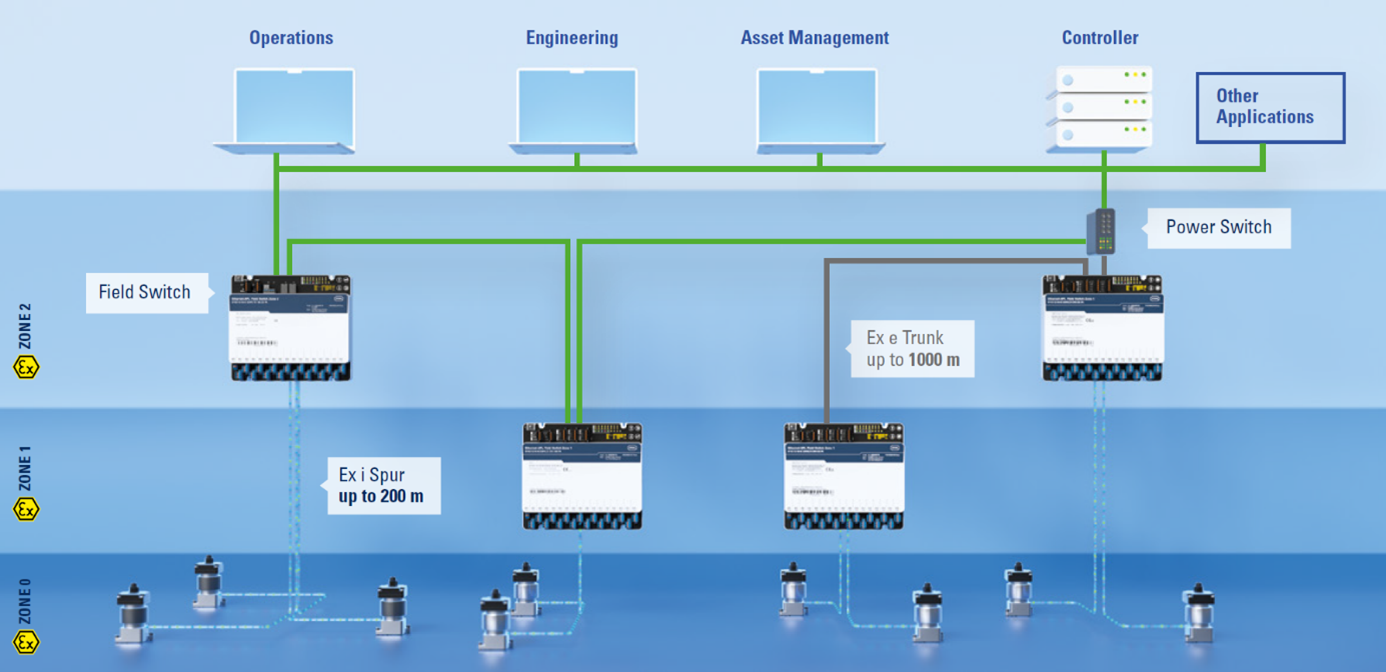
Ethernet-APL Field Switches integrate into standard Ethernet star topologies like industrial switches. They are powered with 24 V or 48 V and communicate via a standard Ethernet backbone such as 100BASE-TX or 100BASE-FX.
They can also be used in ring structures for increased network availability, e.g., in PROFINET networks with MRP ring or S2 redundancy. The Field Switches supply intrinsically safe power over up to 200 m spurs to connected Ethernet-APL field devices via 2-WISE and ensure Ex i communication, including conversion from 10 to 100 Mbit/s.
Depending on the spur configuration (ia, ib, ic), devices can be installed in Zone 0, 1, or 2. The switches are certified for Zone 1 and Zone 2.
They also provide extensive diagnostics for both network and connected devices and can themselves be diagnosed as PROFINET devices. Data can be integrated into higher-level Plant Asset Management systems via FDI – the second NOA channel.
In an alternative trunk-spur topology (for which switches are not yet available), central power supply of up to 92 W is provided via a power switch. This supplies the field switch network, which in turn powers the field devices. However, this requires careful planning due to limited power distribution and currently does not support high-availability ring structures.
Ethernet-APL is supported by four industrial communication standardization organizations: FieldComm Group (FCG), ODVA, OPC Foundation, and PROFIBUS & PROFINET International (PI). These ensure compatibility with protocols such as HART-IP, EtherNet/IP, OPC UA, and PROFINET.
For applications requiring higher bandwidth and power than Ethernet-APL can provide, 100BASE-TX-IS has been specified. It targets complex field devices such as analyzers, operator terminals, and remote I/O systems.
The Intrinsically Safe Ethernet Working Group extends 100BASE-TX Ethernet (IEEE 802.3) with an intrinsically safe frontend, enabling 4-wire Ethernet with data rates up to 100 Mbit/s while remaining fully interoperable with industrial standards.
The core device electronics remain unchanged and are complemented by an Ex i circuit. Additional galvanic isolation may be required.
As with Ethernet-APL, no complex intrinsic safety calculation is required; comparison of compliant devices is sufficient. Since installation parameters are fixed (two devices, point-to-point, max. 100 m CAT5/6/7 cable), a general intrinsic safety verification can be derived based on IEC 60079-25.
Unlike Ethernet-APL, 100BASE-TX-IS does not provide integrated power supply (“Ex i Power over Ethernet”). Distance is limited to 100 m, but media converters with fiber optic interfaces enable much greater distances, up to 30 km or more in Zone 1 using single-mode fibers.
Key question – wait or start now?
With Ethernet-APL, plant implementations are already possible today and are actively being planned by many companies. Both the technology and the required devices are available, and nearly every field device manufacturer already offers products or is close to market introduction.
Remote I/O has already been used for years to digitize existing plants with conventional field devices and integrate them into Ethernet networks.
Ethernet-APL and remote I/O complement each other perfectly in hazardous areas (Zone 1 and 2). While Ethernet-APL enables fully digital communication down to the field level, remote I/O supports integration of existing 4–20 mA devices and simple non-Ethernet field devices such as contacts or solenoid valves. OPC UA provides the NOA access in this context.
End-to-end IP communication from the control room to the field – the goal of digitalization in process automation – is now within reach.
These articles might also interest you

From the Fossil Age to a Hydrogen Future


Lost Password? Why Modern Security Comes with New Rules


![[Translate to Englisch:]](/fileadmin/_processed_/b/f/blog-explosionsschutz-rstahl-startseite-279x205_fd835544b0.jpg?v=fd835544 "[Translate to Englisch:]")
![[Translate to Englisch:]](/fileadmin/_processed_/3/9/blog-explosionsschutz-rstahl-ueber-den-blog-279x205_ba20676840.jpg?v=ba206768 "[Translate to Englisch:]")
![[Translate to Englisch:]](/fileadmin/_processed_/0/d/blog-explosionsschutz-rstahl-autoren-279x205_0fc02e6150.jpg?v=0fc02e61 "[Translate to Englisch:]")
![[Translate to Englisch:]](/fileadmin/_processed_/f/5/blog-explosionsschutz-rstahl-newsletter-expert-mail-279x205_1126e74698.jpg?v=1126e746 "[Translate to Englisch:]")

Write new comment